



Let me ask you something.
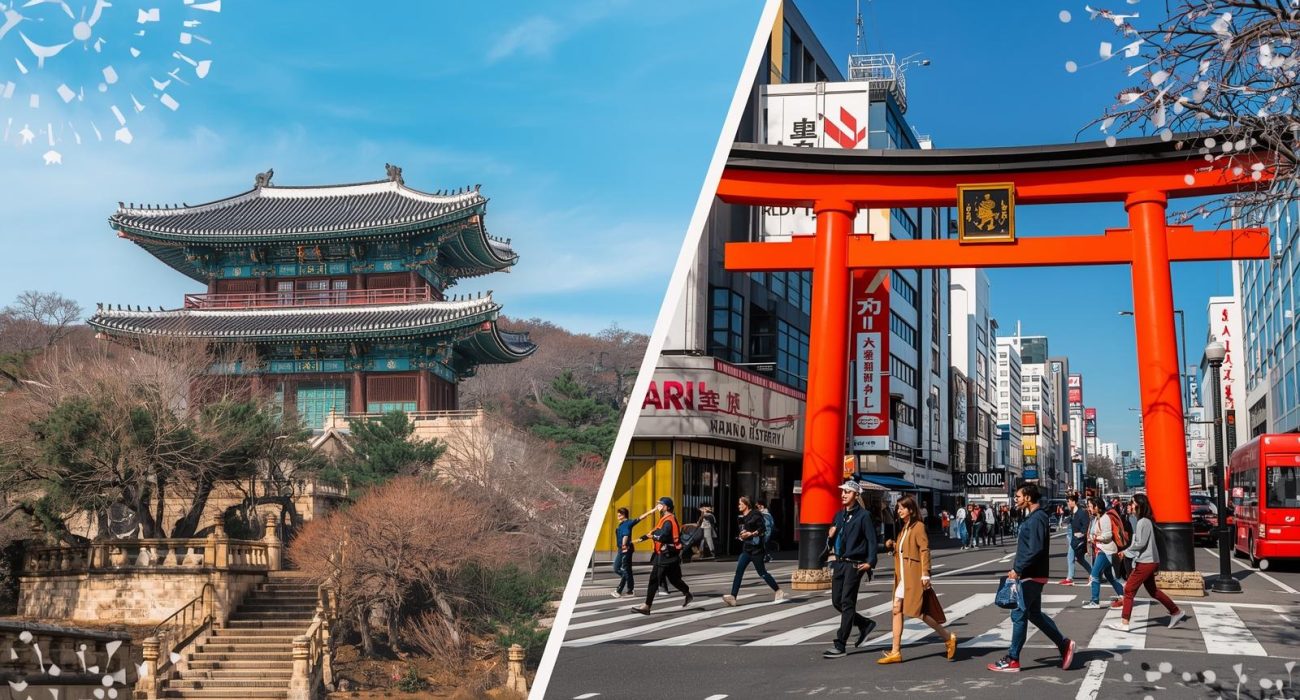
You have been dreaming of Seoul’s neon streets and Tokyo’s neon lights. You want to eat tteokbokki in a pojangmacha and then sushi at Toyosu Market. You want to see the cherry blossoms—or maybe the autumn leaves—two countries in one trip, ten days, go big or go home.
But then reality whispers: Is it realistic? Am I cramming too much? Will I come back more tired than refreshed?
Staring at a map of East Asia, trying to squeeze two incredible countries into one tight schedule. So let me break it down for you, honestly. Yes, you can do Korea and Japan in ten days, but you must do it smartly. This is your realistic itinerary for Indian travellers heading out in 2026.
Before You Go: The 2026 Reality Check (Visa & Planning)
First, let us talk about the paperwork. The dream dies fast if the visa gets rejected.
For Japan: Good news. Japan launched its eVisa system for Indians in April 2024, making the process smoother. From March 2026, walk-in applications are no longer accepted in Chennai, Cochin, Hyderabad, and Puducherry—so you must book an appointment in advance. The eVisa costs around ₹500 (JPY 850) plus a VFS service charge of ₹800. Processing typically takes 5 to 7 working days, so apply at least 3 to 4 weeks before you plan to fly. You will receive a ‘Visa Issuance Notice’ digitally—keep it on your phone for airport check-in.
For South Korea, Indian passport holders need a C-3-9 short-term tourist visa; e-visas are not available for us yet. The standard visa processing fee is approximately KRW 18,000 (around INR 1,100–1,200), which is waived for group tours (five or more people on the same itinerary) until June 2027. The single-entry visa fee is roughly ₹3,500, and processing takes 5-10 working days.
The 10-Day Itinerary: A Balanced Loop
This itinerary assumes you fly into Seoul (ICN), take a short flight across to Tokyo (NRT/HND), and fly back to India from Tokyo. Or you can reverse it. The key is to pick two hubs—Seoul and Tokyo—and explore deeply rather than hopping five cities aimlessly.
Day 1–4: South Korea (Seoul & Around)
Day 1: Arrive in Seoul. Settle in Myeongdong or Hongdae for easy access to street food and transport. Visit N Seoul Tower at sunset.
Day 2: Dive into history and modern Korea. Gyeongbokgung Palace (free entry if you wear a hanbok), National Folk Museum, then wander Bukchon Hanok Village. Evening in Insadong for traditional crafts.
Day 3: DMZ half‑day tour (must pre‑book)—you will see the infamous border and the tunnels. Afternoon exploring Hongdae’s quirky cafes and street performances.
Day 4: Morning at Namsangol Hanok Village or a K‑pop experience at HiKR Ground. Take an afternoon flight from Seoul (ICN) to Tokyo (NRT). The flight is about two and a half hours.
Day 5–10: Japan (Tokyo, Kyoto, Osaka)
Day 5: Arrive in Tokyo. Hit the ground running: Asakusa’s Senso‑ji Temple, the bustling Nakamise‑dori street, and an evening at Tokyo Skytree.
Day 6: Hop on a shinkansen (bullet train) to Kyoto early morning. Visit Fushimi Inari Shrine (thousands of red torii gates), Kinkaku‑ji (Golden Pavilion), and Arashiyama Bamboo Grove. Stay overnight in Kyoto for the full cultural immersion.
Day 7: Morning in the Gion district (maybe spot a geiko or maiko), then travel to Osaka. Dotonbori at night for neon lights and takoyaki.
Day 8: Osaka’s highlights: Osaka Castle and Universal Studios Japan (if you are into theme parks). Late afternoon shinkansen back to Tokyo.
Day 9: Tokyo modern side: Shibuya Crossing, Meiji Shrine, Harajuku’s Takeshita Street, and teamLab Planets (book weeks ahead). Dinner in Shinjuku’s Omoide Yokocho.
Day 10: Last‑minute shopping in Akihabara (anime/electronics) or Ginza (luxury). Fly out from Narita or Haneda.
When to Go: Cherry Blossoms, Autumn Leaves & Summer Festivals
The best time for this combined trip is spring (late March to early April) for cherry blossoms, or autumn (October to November) for crisp weather and fall foliage. Japan and South Korea top Indian travellers’ spring lists, driven by the iconic sakura bloom. Summer (June–August) is humid and rainy, but you will catch festivals like Tokyo’s Sumidagawa Fireworks. Winter offers fewer crowds and lower costs, but pack for cold weather.
Practical Tips for Indian Travelers
Vegetarian food: Tougher in Japan (broths often contain fish), easier in Korea (kimchi and bibimbap can be veggie). Carry instant noodles and learn phrases like “watashi wa bejitarian desu” (I am a vegetarian).
Transportation: Buy a T‑money card in Seoul for subways/buses, and a SUICA/Pasmo in Tokyo. For the Shinkansen, consider a JR Pass if you take at least three long journeys.
Connectivity: Rent a pocket Wi‑Fi device at Incheon or Narita airport, or buy a local eSIM (e.g., Ubigi, Airalo) before departure.
Language: English is more widely spoken in South Korea’s tourist areas than in Japan. Download Papago (Korean translator) and Google Translate with offline Japanese packs.
Money: Carry some cash (especially in Japan). International ATMs are found at 7‑Eleven, FamilyMart, and post offices.
A Final Word from Someone Who Has Done It
Ten days is short. You will not see everything. But you will taste two extraordinary cultures back-to-back—from the energetic, spicy, warm streets of Seoul to the calm, precise, neon‑lit alleys of Tokyo. So plan well, pack light, get your visas early, and go chase that sunrise over Incheon Airport, knowing Tokyo is just a two‑hour flight away.
You may also like reading:
Flight Cancellation Refund Rules 2026: DGCA New Policy Guide
Why South America Is the Next Big Travel Destination for Indians